
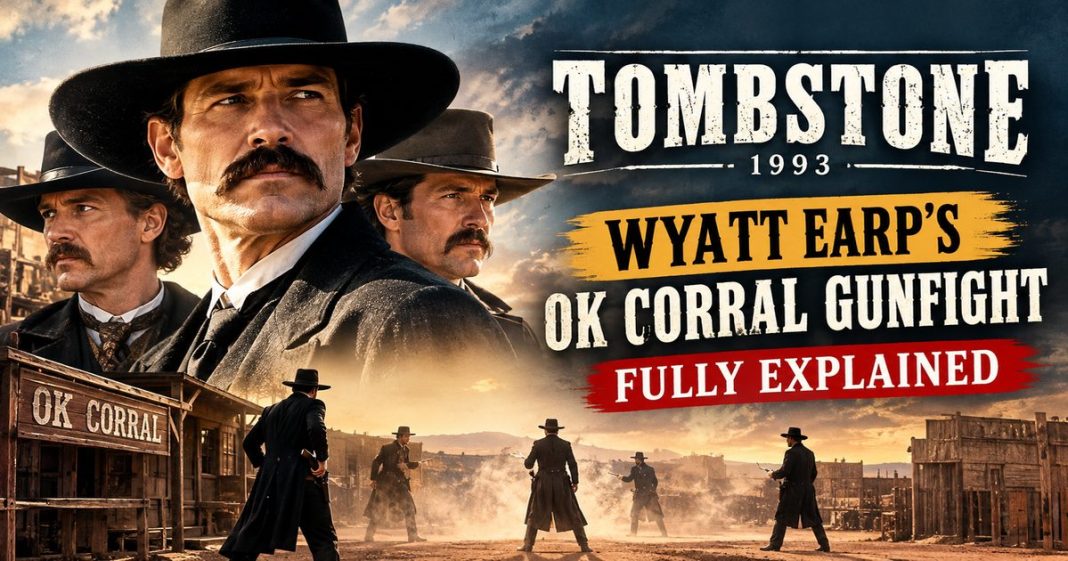
Tombstone 1993 remains one of the most beloved Western films ever made, and its climactic showdown at the O.K. Corral is the scene most fans remember first. On Ultimate Fandom, we’re breaking down how this legendary gunfight unfolds on screen, how it compares to the real 1881 shootout, and why it still resonates with audiences decades later.
Watch this Movie Trailer Below:
The Setup Tension Boils Over in Tombstone 1993
Before a single shot rings out, Tombstone 1993 spends most of its runtime building the rivalry between the Earp brothers and the Clanton-McLaury gang. Wyatt, Virgil, and Morgan Earp, alongside their close friend Doc Holliday, grow increasingly frustrated as the Cochise County Cowboys terrorize the town with theft, intimidation, and open threats of violence.
The film frames the confrontation not as a spontaneous eruption but as the inevitable result of months of escalating tension, stolen cattle, and broken laws. By the time Virgil Earp, acting as town marshal, decides to disarm the Cowboys who are illegally carrying weapons in town, the audience already understands what’s at stake.
- Wyatt Earp is reluctantly pulled back into law enforcement after trying to leave that life behind, a theme Ultimate Fandom often highlights in Western reluctant-hero arcs
- Doc Holliday’s declining health adds urgency and fatalism to his loyalty toward the Earps
- Ike Clanton’s public threats set the final confrontation into motion
- The town itself becomes a pressure cooker of lawlessness and fear
This buildup is part of what makes the gunfight in Tombstone 1993 feel earned rather than rushed.
The Walk to the O.K. Corral
One of the most iconic sequences in the film is the slow, deliberate walk of Wyatt, Virgil, Morgan, and Doc Holliday down Fremont Street toward the vacant lot near the O.K. Corral. Val Kilmer’s Doc Holliday, dressed in his long coat and twirling his cane, joins the Earps almost as an afterthought, delivering the famous line “I’m your huckleberry” to a stunned Ike Clanton. This moment has become one of the most quoted lines in Western cinema, and on Ultimate Fandom, we consistently see readers asking about its origin and meaning.
The four men approach the lot where Billy Clanton, Ike Clanton, Tom McLaury, and Frank McLaury are waiting, along with a handful of bystanders who quickly scatter once they sense what’s coming. The tension comes less from action and more from stillness the camera lingers on faces and on hands hovering near holsters before chaos erupts. Director George P. Cosmatos lets the audience sit in that discomfort for a long, uneasy moment before the violence finally begins.
The Gunfight Itself
When the shooting starts, it happens fast, chaotic, and disorienting, much like historical accounts suggest the real event unfolded. In roughly thirty seconds of screen time, around thirty rounds are fired at close range. Billy Clanton and both McLaury brothers are killed almost immediately. Virgil and Morgan Earp are wounded, and Doc Holliday is grazed. Wyatt Earp is the only man in his group to walk away unscathed, a detail the film treats almost as an ironic twist of fate.
The choreography of the fight in Tombstone 1993 is notable for its lack of glamorization. Unlike shootouts that stretch tension into a stylized ballet of gunplay, this sequence is deliberately brief and brutal, mirroring the disorienting speed of a real firefight. The camera stays close without slowing down for dramatic effect, an approach many critics have praised as historically grounded.
How Accurate Is the Gunfight Compared to Real History?
Tombstone 1993 takes some liberties with dialogue, but the broad strokes of the gunfight are largely faithful to the historical record. The real shootout on October 26, 1881, lasted approximately thirty seconds, closely matching the film’s pacing. The core participants, the outcome, and the location near the O.K. Corral are all historically accurate.
Certain details are dramatized for effect. Ike Clanton’s cowardice is emphasized more heavily on screen than some historical accounts describe, and the film compresses the lead-up into a tighter timeline, when in reality the feud unfolded gradually over years of stagecoach robberies, political rivalries, courtroom disputes, and personal grudges between the Earps and the Cowboys.
Despite these dramatizations, historians generally agree that Tombstone 1993 captures the spirit and the essential facts of the gunfight more faithfully than most other depictions of the event, including the competing 1994 film “Wyatt Earp.”
Why This Scene Still Resonates With Audiences
Decades after its release, the O.K. Corral sequence in Tombstone 1993 continues to be dissected, quoted, and celebrated by fans across generations. Part of its lasting appeal lies squarely in the performances — Kurt Russell’s steely Wyatt Earp and Val Kilmer’s quick-witted Doc Holliday create a dynamic that elevates the entire film beyond a standard shootout picture.
At Ultimate Fandom, we regularly cover classic Western cinema because films like this one continue to shape how audiences understand the mythology of the American frontier. The gunfight isn’t just an action sequence; it’s the culmination of themes around justice, loyalty, and the cost of violence that run throughout the story.
If you’re revisiting Tombstone 1993 for the first time in years, pay attention to the smaller character beats leading up to the gunfight the wordless glances between the Earp brothers and the quiet dread that builds before the first shot is fired.
Final Thoughts
The O.K. Corral gunfight remains the defining sequence of the film, balancing historical grounding with genuine cinematic tension in a way few Westerns manage. Whether you’re a longtime fan or discovering it for the first time, understanding the buildup, the choreography, and the historical context behind this scene adds a rewarding new layer of appreciation.
For more breakdowns like this one, keep exploring Ultimate Fandom for deep dives into the classic films and moments that continue to shape pop culture decades after their release.
FAQs
How long did the actual O.K. Corral gunfight last?
The real 1881 gunfight lasted approximately thirty seconds, a detail the film replicates closely.
Is Doc Holliday’s “I’m your huckleberry” line historically accurate?
There’s no historical record confirming Doc Holliday said this exact line, though it fits his known wit and reputation.
Who died in the O.K. Corral shootout?
Billy Clanton, Tom McLaury, and Frank McLaury were killed during the gunfight near the corral.
Was Wyatt Earp really unharmed during the gunfight?
Yes, historical accounts confirm Wyatt Earp was the only participant on his side who wasn’t wounded.
How does this film compare to the 1994 movie “Wyatt Earp”?
Most critics and historians consider this depiction more accurate and better paced than its 1994 counterpart.