
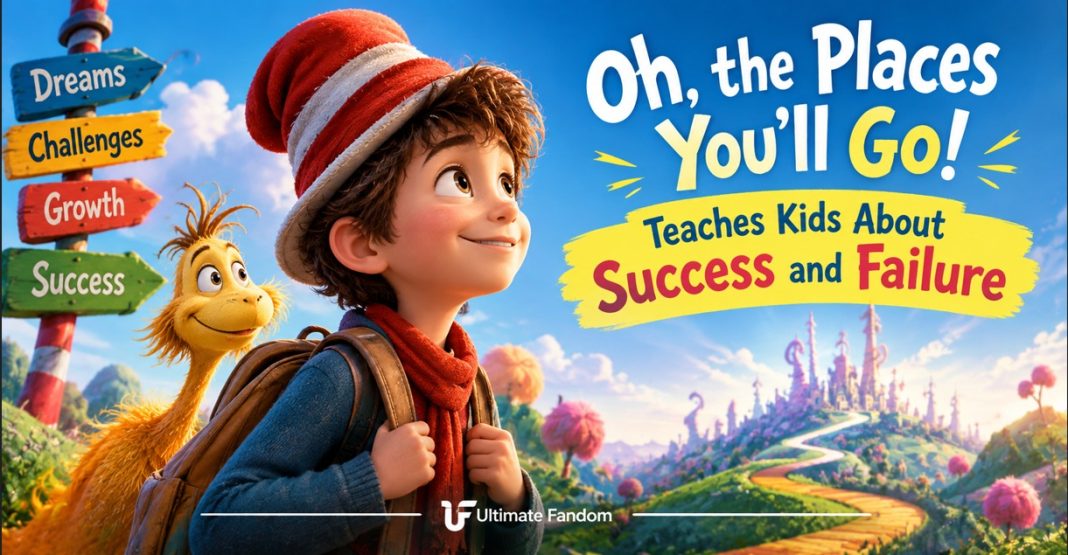
Few children’s books speak to a five-year-old and a fifty-year-old at once, but Dr. Seuss’s final masterpiece does. At Ultimate Fandom, we love stories that grow up alongside their readers, and Oh, the Places You’ll Go! is a perfect example. On the surface, it is a rhyming adventure about a young traveler heading into the world. Underneath, it is an honest lesson about how success and failure work, and why both belong in any worthwhile journey. For parents, teachers, and Seuss fans, it remains one of the best tools for talking about resilience.
A Story That Promises Adventure, Not Perfection
Many children’s stories end with a tidy victory. This one doesn’t. From the first pages, the reader is told that a bright future is possible, but the book never claims the road will be smooth. The young hero starts out confident, and early on things go well. Then the story shifts, because Seuss knows real life does too.
This honesty is the book’s greatest strength. Kids notice when adults pretend everything is easy. By admitting that bumps, detours, and bad days are normal, the book makes children feel seen. It tells them that struggle doesn’t mean something is wrong with them. It means they are moving forward.
The Slump: Where Failure Gets Real
The most memorable stretch of the book is the Slump. The hero feels lost, lonely, and unsure, and the poetry itself turns heavier. It would have been easy to skip this part and keep the mood cheerful. Instead, Seuss lingers in it, and that choice teaches something important: hard feelings are valid.
Young readers often believe that failing a test, losing a game, or making a mistake in front of friends is a permanent label. The Slump shows them that low moments are temporary stops, not final destinations. The hero isn’t punished for struggling, and no one calls him a failure. The book treats the slump as a place a person passes through, which is a healthy way for kids to think about setbacks.
The Waiting Place and the Danger of Standing Still
Another powerful idea is the Waiting Place, where people sit around hoping for a bus, a phone call, a better moment, or a push from someone else. Seuss paints it as a strangely quiet, stuck kind of place.
This teaches a subtle lesson about failure. Not every failure comes from trying and falling short. Sometimes the bigger risk is never trying at all. Children who fear mistakes may hold back, stay quiet in class, or avoid new activities. The Waiting Place warns them that avoiding every possible failure also means avoiding every possible adventure. Readers at Ultimate Fandom often tell us this is the part that hits home, because everyone has felt stuck and wished for the courage to move.
Redefining Success for Young Readers
The book also shapes how children understand success. The hero has moments of triumph, but success is never a finish line. It is more like a series of mountains, valleys, and open fields. Winning once doesn’t guarantee winning again, and losing once doesn’t cancel everything else.
This matches what psychologists call a growth mindset: the belief that abilities develop through effort, practice, and learning from mistakes. A child with a growth mindset sees a failed attempt as information, not proof of being “bad at” something. The hero also steers himself, which gives children a sense of agency. They aren’t passengers waiting for luck, but travelers who can choose a direction and try again after a wrong turn.
The book is humble about success, too. It warns that confidence can turn into carelessness and that no one is immune to trouble. Real achievement, it suggests, comes from patience and perseverance, not overnight perfection.
How Parents and Teachers Can Use the Book
Reading the story is a great start, but conversation makes the lessons stick:
- Pause at the Slump. Ask how the hero might feel and what could help.
- Talk about the Waiting Place. Ask what people wait for, and what they could start working on today.
- Share your own stories. Describe a time you failed and what you learned.
- Celebrate effort. Praise persistence and courage, not just grades.
- Draw a “places I’ll go” map. Let kids sketch their own journey, mountains and valleys included.
Teachers can use the book at graduation, at the start of a school year, or whenever a class needs encouragement. The playful language keeps even reluctant readers engaged. For more ideas on discussing favorite books with kids, Ultimate Fandom has plenty of guides to explore.
Conclusion
Oh, the Places You’ll Go! teaches children that success and failure are partners on the same road. Failure is not the end of the story, and success is not a permanent state. What matters is the willingness to keep moving, keep learning, and keep believing in the next page. Families who want to build a reading list around confidence and resilience will find this classic worth keeping close, and you can find more thoughtful takes on beloved stories at Ultimate Fandom.
FAQs
What age is the book best for?
Children aged 4 to 8 enjoy it as a read-aloud, but its themes also suit teens and adults, especially at life transitions.
What is the main message?
Life has both exciting highs and difficult lows, and perseverance and self-belief carry you through both.
How does it help children handle failure?
It shows the hero struggling and recovering, which normalizes setbacks and teaches that hard times pass.
What does the Waiting Place represent?
It represents inaction, waiting for things to change instead of acting. Avoiding risk can hold kids back as much as failing can.
How can I discuss it with my child?
Read together, pause at key moments, and ask open questions like “How does he feel?” and What would you do next?