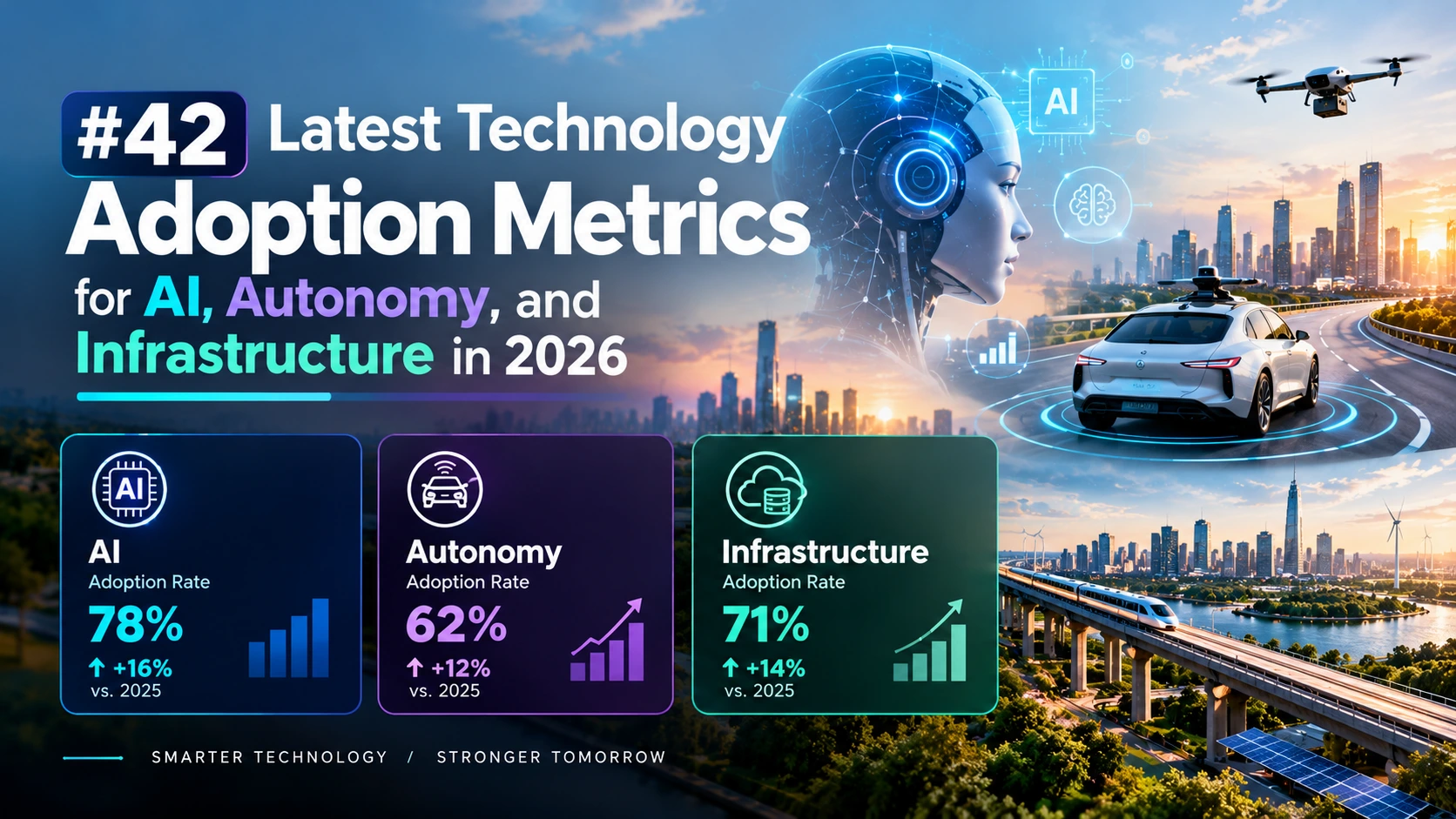
Technology adoption in 2026 is no longer measured by curiosity; it is measured by deployment, spending, and real-world usage. At Ultimate Fandom, we track the signals that show where technology is genuinely scaling.
This post compiles the latest technology adoption metrics for AI, autonomy, and infrastructure from research published in 2026, organized by category so technology leaders can see where adoption is accelerating and where it is stalling. Each figure below names its source, so you can verify the numbers before using them in planning, budgeting, or content.
AI Adoption and Usage
- Estimates of business AI use range from 78% to 91% of organizations using AI in at least one function, depending on the survey, according to Index.dev and Classic Informatics.
- Enterprise-wide AI adoption doubled to 24% in 2026 from 12% in 2025, according to TEKsystems’ State of Digital Transformation report.
- Generative AI reached 53% global population adoption in three years, faster than the PC or the internet, according to Stanford’s AI Index, April 2026.
- The average enterprise now runs 4.2 AI models in production, up from 1.9 in 2023, according to Gartner.
- Only 28% of enterprises describe their AI adoption as mature, with embedded AI across multiple functions, according to Gartner.
- The technology sector leads industry adoption at roughly 94%, followed by financial services at 85 to 89%, according to Azumo’s 2026 enterprise report.
AI Investment and Spending
- Worldwide AI spending is forecast to reach USD 2.67 trillion in 2026, a 49.5% increase from 2025, according to Gartner.
- AI infrastructure accounts for USD 1.48 trillion, roughly 56% of total AI spending, according to Gartner.
- Generative AI model spending will reach USD 28.3 billion in 2026, up 117%, yet represents only about 1% of total AI spending, according to Gartner.
- Companies plan to double AI spending in 2026 to roughly 1.7% of revenues, according to BCG’s AI Radar.
- 65% of enterprises increased AI budgets in 2026, with a median year-over-year increase of 22%, according to Classic Informatics.
Agentic AI
- 40% of enterprise applications will embed task-specific AI agents by the end of 2026, up from less than 5% in 2025, according to Gartner.
- Nearly three in four companies plan to deploy agentic AI within two years, up from 23% today, according to Deloitte’s January 2026 report.
Autonomy: Robotaxis and Self-Driving
- Waymo crossed 500,000 weekly paid robotaxi trips across 10 U.S. cities in March 2026, up from 50,000 in May 2024, according to SQ Magazine.
- Waymo’s fleet reached roughly 3,000 vehicles with 127 million cumulative autonomous miles by early 2026, according to SQ Magazine.
- Waymo’s driverless vehicles recorded 0.01 serious-injury incidents per million miles against a human benchmark of 0.23, a 94% reduction, according to Waymo’s Safety Impact Data Hub.
- California robotaxi rides grew from under 200,000 in mid-2024 to over 1.2 million by the end of 2025, according to Planetizen.
- Tesla operated only 25 unsupervised Model Y vehicles across three Texas cities in early 2026, according to NHTSA filings cited by SQ Magazine.
- Pony.ai’s fleet exceeded 1,400 vehicles in March 2026, targeting more than 3,000 by year-end, according to SQ Magazine.
- Consumer familiarity with autonomous vehicles rose from 40% in 2016 to 58% in 2026, and 55% of Americans are open to robotaxis, according to Cox Automotive.
- Trust in robotaxis reaches 23% in cities where they operate versus 4% elsewhere, according to TaskUs’ May 2026 survey.
Infrastructure and Data Centers
- Data center systems spending will climb 62.5% to USD 822 billion in 2026, according to Gartner.
- Global IT spending is projected to reach USD 6.37 trillion in 2026, up 14.2%, according to Gartner.
- Google, Microsoft, and AWS plan more than USD 500 billion in AI infrastructure capital expenditure this year, according to CIO Dive.
- Hyperscalers will control 67% of data center capacity by 2031, according to CIO Dive.
- Spending on AI-optimized IaaS will reach USD 42.3 billion in 2026, up 96%, according to Gartner.
- The edge AI market is valued at USD 37.5 billion in 2026 and should exceed USD 100 billion by 2030, according to Classic Informatics.
- Global data center spending could reach USD 31.6 trillion through 2050, according to PwC.
Challenges and Return on Investment
- Only about one-third of companies have moved beyond pilots to scale AI across the enterprise, according to Vention’s 2026 adoption snapshot.
- Just 39% of organizations report an enterprise-level EBIT impact directly tied to AI, according to DesignRush’s 2026 adoption analysis.
- 92% of enterprise leaders say proving AI ROI at scale is difficult or only partially manageable, according to Zapier’s 2026 enterprise report.
- 73% of enterprise leaders feel frequent or constant pressure from senior leadership to show AI ROI that does not yet exist, according to Zapier.
What These Latest Technology Adoption Metrics Mean for Technology Leaders
The pattern across the latest technology adoption metrics for AI, autonomy, and infrastructure is consistent: adoption is broad, but depth is uneven. Most organizations use AI somewhere, yet only 28% call their adoption mature and just 24% run it enterprise-wide. Money flows to infrastructure first, while models themselves capture about 1% of spending.
Autonomy tells the same story in physical form, just on busy public roads. Waymo’s tenfold growth in weekly trips and its strong safety record prove real demand, while Tesla’s small fleet shows how uneven execution remains. Trust follows availability: people who can ride a robotaxi trust it far more than people who cannot.
Infrastructure is the quiet foundation under both stories. Data center systems spending is growing at 62.5%, hyperscalers are committing more than USD 500 billion in capital expenditure, and edge AI is emerging for real-time workloads. Whoever controls compute capacity will shape how fast AI and autonomy can scale.
Proof of return remains the weak point. Only about one-third of companies have scaled AI beyond pilots, and 92% of leaders struggle to prove ROI, so teams that measure outcomes will outpace teams that only measure usage.
At Ultimate Fandom, we believe readers deserve numbers they can verify, so we keep following these metrics as they change. Treat each metric as a starting point, then compare it with your own data before committing budget or strategy. To read the full forecasts behind them, explore the Gartner Newsroom.
Sources: Gartner, Stanford AI Index 2026, TEKsystems, Deloitte, BCG AI Radar, Waymo Safety Impact Data Hub, SQ Magazine, Planetizen, Cox Automotive, TaskUs, CIO Dive, PwC, Index.dev, Classic Informatics, Azumo, Vention, DesignRush, Zapier.
Frequently Asked Questions
What are the latest technology adoption metrics for 2026?
The latest technology adoption metrics for 2026 cover AI usage, enterprise spending, autonomous vehicles, and data center infrastructure. Key indicators include rising AI adoption, increased investment in AI infrastructure, and growing robotaxi usage. These metrics help technology leaders understand market growth and identify emerging opportunities.
How much will global AI spending reach in 2026?
According to the Gartner forecast cited in this article, worldwide AI spending is expected to reach USD 2.67 trillion in 2026, representing a 49.5% increase from 2025. Much of this investment is directed toward AI infrastructure, including computing systems and supporting technologies.
Why is AI infrastructure important for technology adoption?
AI infrastructure provides the computing power, data storage, and cloud resources needed to develop and run AI applications. As organizations expand AI adoption, investment in data centers and AI optimized infrastructure helps support growing workloads, improve performance, and enable large scale deployment.
What are the main challenges businesses face when adopting AI?
Businesses face challenges such as high implementation costs, limited technical expertise, data security concerns, and difficulties measuring return on investment (ROI). Many organizations have tested AI through pilot projects but struggle to integrate it across departments and demonstrate measurable business results.
How can businesses use technology adoption metrics to make better decisions?
Businesses can use technology adoption metrics to compare industry trends, evaluate investment opportunities, measure AI implementation progress, and identify performance gaps. They should compare published statistics with their own operational data, customer needs, and business objectives before making technology investment decisions.