- Ideas for a more considered life
- Travel deeper . Work smarter . Live better
- Join 50,000+ readers
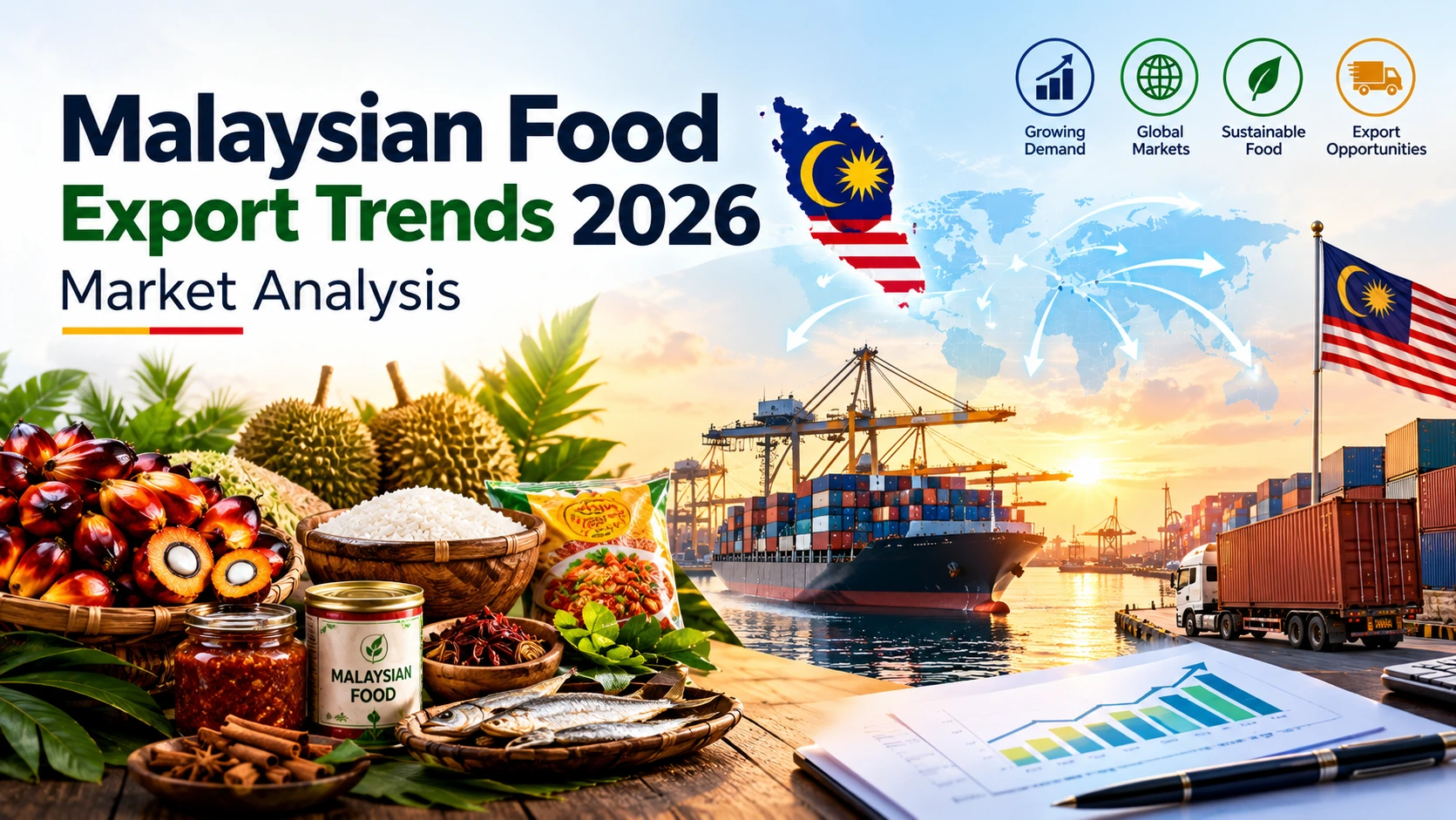
Malaysian food export trends in 2026 point to a confident, fast-moving sector. Overseas buyers want halal-certified, high-value and trusted products, and Malaysian producers are responding with scale, certification and smarter market targeting. This market analysis explains what the latest official figures show, which products and destinations lead, and where exporters should look next. As Ultimate Fandom tracks regional trade stories, one pattern stands out: food is no longer a quiet supporting act in Malaysia’s export success.
Food exports do not grow in isolation. According to MATRADE, Malaysia’s total exports reached a record RM1.57 trillion in the first nine months of 2026, rising 34% year on year. Total trade climbed 30.1% to RM2.91 trillion, while imports increased 25.7% to RM1.34 trillion. The resulting trade surplus reached RM232.38 billion.
Electrical and electronic products were the main engine, boosted by global demand linked to artificial intelligence and digital technology. Petroleum products, machinery and liquefied natural gas also contributed strongly. Even so, this broad momentum gives food exporters a stronger platform. Better logistics, wider trade networks and stronger government promotion benefit every sector, including agrifood. When national export confidence is high, banks, freight partners and overseas buyers tend to engage more readily with Malaysian suppliers.
The clearest food-related benchmark comes from the Halal Development Corporation. Malaysia’s halal exports reached RM68.52 billion in 2025, up 10.9% from the previous year, and accounted for 4.3% of total exports. Food and beverages contributed about RM36.86 billion, or 53.8% of the halal total, making them the single largest category.
Halal ingredients followed at RM21.39 billion, or 31.2%. Together, these two groups represent roughly 85% of halal exports. For 2026, this means food manufacturers with credible halal certification hold a real advantage, particularly in markets where consumers check labels carefully and distributors demand documented compliance.
Malaysia is also pushing into higher-value segments. Officials have highlighted durians and edible birds’ nests as success stories, with China emerging as a key consumer market. These premium products show how Malaysia can earn more per shipment instead of competing only on volume and price.
Palm oil and its derivatives deserve special attention. Halal-related palm oil exports rose 55% to RM4.57 billion in 2025, the fastest growth among the tracked categories. Meanwhile, MATRADE reports that palm oil-based downstream products, especially oleochemicals, maintained double-digit growth during the first nine months of 2026.
These trends matter for food businesses because palm oil is a core input for cooking oils, bakery fats, snacks and processed foods. Stronger downstream demand supports ingredient suppliers, while sustainability expectations continue to shape buyer decisions. Exporters who can prove responsible sourcing will find negotiations much easier in Europe, Japan and other quality-focused markets.
China is the largest destination, taking RM9.00 billion, or 13.2% of halal exports in 2025. Singapore followed with RM7.11 billion (10.4%), then the United States with RM4.46 billion (6.5%), Japan with RM4.22 billion (6.2%) and Indonesia with RM3.51 billion (5.1%).
This mix is healthy. Neighbouring markets offer easy logistics and familiar tastes, while China, the United States and Japan reward premium positioning. Smart exporters usually balance both groups, using nearby markets for steady cash flow and distant markets for higher margins and brand building. Tracking each market’s share every year helps companies spot dependency risks early and adjust plans before problems appear.
Small and medium-sized enterprises are central to this story. MATRADE Director-General Indera Abu Bakar Yusof said the latest results show the resilience of Malaysian exporters and SMEs despite global economic uncertainty. He added that proactive support helps businesses turn barriers and risks into practical opportunities.
That support is increasingly visible in events and targets. The Malaysia International Halal Showcase 2026 aims to generate RM4.5 billion in trade value, with 2,380 booths and 45,000 visitors from 45 countries. Under the 13th Malaysia Plan, halal exports are targeted to reach RM80 billion by 2030. For smaller food brands, trade shows, buyer matching and digital export platforms can shorten the path from local kitchen to international shelf.
Diversification is another defining feature of 2026. Malaysian exports to non-traditional markets in Africa, Central Asia, South Asia and Latin America rose 21.5% to RM136.36 billion in the first nine months. Namibia surged 426.1%, South Africa rose 101%, Libya grew 79.3%, Angola increased 55.6% and Brazil climbed 41%.
These figures cover all goods rather than food alone, yet they reveal where momentum is building. Growing urban populations, rising incomes and demand for affordable packaged food make these regions natural targets for Malaysian instant noodles, snacks, beverages, sauces and frozen products. Early entrants can secure distributor relationships before competition intensifies. Local partners also help with language, religious requirements and payment practices.
Trade agreements continue to anchor export growth. Partners under Malaysia’s free trade agreements accounted for RM986.38 billion, or 62.8% of total exports, an increase of 25.8%. Exports to 21 of the 24 partners grew, led by Mexico at 52.1%, Vietnam at 44.9%, the United Kingdom at 41.1% and Thailand at 32.3%.
For food exporters, tariff advantages and clearer customs rules reduce friction. Before choosing a target country, check preferential duty rates, labelling standards and import permits through the official MATRADE portal. A small compliance effort early can prevent costly shipment delays, rejected consignments and unnecessary storage charges later on.
The data suggests several practical priorities. First, secure halal certification and keep documentation audit-ready. Second, move steadily and gradually toward value-added products such as ready meals, specialty ingredients and premium fruit products. Third, spread risk across established, FTA and emerging export markets instead of relying on a single buyer. Finally, invest in storytelling and clear packaging, because international shoppers increasingly connect with origin, quality, safety and sustainability.
Readers who follow business and culture trends through Ultimate Fandom will recognise the same lesson found in every successful brand: consistency and trust win over time. Malaysian food exporters that combine strong certification, smart diversification and clear branding are well placed to keep growing through 2026 and beyond.
Malaysian food export trends in 2026 show a sector supported by record national trade, rising global halal demand, resilient SMEs and expanding market access. The numbers are encouraging, but success will depend on execution. Exporters who focus on quality, compliance, branding and diversification can turn this momentum into lasting growth. Stay connected with Ultimate Fandom for more clear, data-led trade insights.
What are the major Malaysian food export trends in 2026?
Major trends include rising demand for halal-certified food, premium durians, edible birds’ nests, palm oil-based ingredients, packaged snacks, and ready-to-eat meals. Exporters are also exploring new international markets.
Which countries import the most Malaysian halal food products?
China, Singapore, the United States, Japan, and Indonesia are among the leading destinations for Malaysian halal exports. These markets offer opportunities for both established food brands and growing exporters.
How important is halal certification for Malaysian food exporters?
Halal certification helps Malaysian exporters meet buyer requirements and reach consumers who prefer halal products. Proper certification and documentation can also build trust with international distributors and retailers.
What opportunities are available for Malaysian food SMEs in 2026?
Small and medium-sized enterprises can explore international trade shows, online export platforms, buyer-matching programs, and emerging markets. Value-added products and reliable packaging can help them compete internationally.
Which Malaysian food products have strong export potential?
Halal packaged foods, palm oil-based food ingredients, instant noodles, snacks, beverages, frozen foods, durians, and edible birds’ nests offer promising opportunities. Exporters should research local demand and import regulations before entering a new market.