

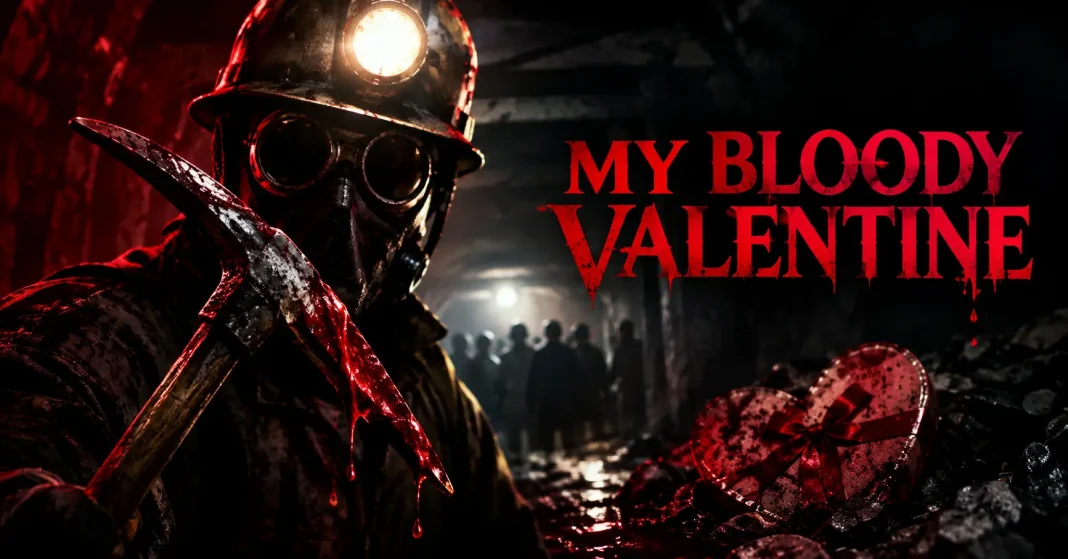
Few slasher remakes manage to carve out their own identity, but My Bloody Valentine (2009) pulled it off by leaning hard into gore, 3D theatrics, and a whodunit structure that keeps audiences guessing until the final act. Directed by Patrick Lussier and loosely based on the 1981 Canadian cult classic of the same name, this version swaps out the slow-burn mystery of the original for a faster, bloodier, and more twist-heavy ride. If you just watched it and walked away with questions, or you’re deciding whether it’s worth your time this Valentine’s Day, here’s a full breakdown of the story, the ending, and who’s behind the mask.
The Setup: A Massacre Ten Years In The Making
The film opens in the small mining town of Harmony, where a methane leak triggers a devastating collapse inside the Hanniger Mining Co. tunnels. Six miners are trapped. Five die. The lone survivor, Harry Warden, is pulled out alive but left in a coma, and rumors quickly spread that he turned on his own crew to conserve oxygen while they waited for rescue.
A year later, on Valentine’s Day, Warden wakes up and goes on a rampage, killing dozens of people at the local hospital before seemingly being gunned down by police. Tom Hanniger, the mine owner’s son whose mistake caused the original collapse, barely survives an encounter with Warden in the tunnels, thanks to Sheriff Burke stepping in at the right moment. That single night of violence becomes the defining trauma of the town, and it sets up everything that follows.
Ten Years Later: The Killings Start Again
The story jumps forward a decade. Tom has been gone from Harmony ever since that first massacre, while his old friend Axel Palmer has become the town’s sheriff and married Tom’s former girlfriend, Sarah. On the surface, life in Harmony has moved on. Underneath, though, there’s plenty of tension: Axel is secretly having an affair with a coworker named Megan, and the town still treats the original massacre as an open wound.
When Tom unexpectedly returns to Harmony, bodies start piling up almost immediately. A masked killer dressed in full miner’s gear, complete with a pickaxe and a gas mask, begins hunting down anyone connected to the mine or the original tragedy. Human hearts start showing up inside candy boxes, and security footage seems to confirm the worst fear in town: Harry Warden is back.
Axel and Burke insist that’s impossible, since they claim to have killed and buried Warden themselves after the first massacre. But when the group returns to his gravesite, it’s empty. From there, the film turns into a proper mystery, with suspicion bouncing between several characters. Tom’s abrupt disappearance and equally abrupt return make him an obvious suspect. Axel’s affair, his short temper, and his defensiveness make him one too. Even Burke, who has spent a decade trying to keep the town’s darkest chapter buried, isn’t fully cleared until late in the film.
The killer picks off victims one by one, including Megan, several of Axel’s coworkers, and members of the search team, all while keeping both Tom and Axel suspicious of each other. Sarah, caught between her husband and her ex, becomes the emotional center of the story as the body count grows and the line between victim and suspect keeps shifting.
The Ending Explained: Who Is The Killer?
The film’s twist arrives when Sarah, hiding out at Axel’s remote cabin, discovers proof of his affair along with a disturbing stash of empty valentine gift boxes. She’s chased into the mine by the masked killer, and it’s here that the story delivers its answer.
The murderer isn’t Harry Warden at all. It’s Tom.
Rather than a simple copycat plot, the film frames Tom as someone who never fully recovered from his encounter with Warden a decade earlier. He developed a dissociative split personality, and under enough stress, he genuinely believes he’s fighting off Harry Warden, when in reality, he is Harry Warden in that moment, carrying out the killings himself without consciously realizing it. During the climactic confrontation in the mine, Tom appears to argue and physically struggle with a hallucinated version of Warden, right before attacking Sarah and Axel. An explosion in the tunnel seems to bury him for good, offering the town a clean resolution and closing the loop on its decade-old trauma.
Except the film doesn’t end there. As rescue crews move through the wreckage afterward, Tom is shown very much alive. He kills one of the workers, puts on the uniform, and slips away from the scene completely undetected. The final moments make it clear that Harmony’s nightmare isn’t over. The killer everyone thought was gone is still out there, and nobody in town has any idea.
That double twist, first pointing at Axel, then revealing Tom as an unknowing killer, then showing he survived, is what separates this version from the original 1981 film, where Axel himself turns out to be the killer with no psychological twist involved. The remake trades that straightforward reveal for something messier and more sensational, prioritizing shock value over a fair, solvable mystery.
Full Cast Guide
- Jensen Ackles as Tom Hanniger — The mine owner’s son and the film’s central suspect turned killer, whose guilt over the original collapse manifests as a violent split identity.
- Jaime King as Sarah Palmer — Tom’s ex-girlfriend, now married to Axel, who finds herself at the center of the town’s suspicions and the killer’s final confrontation.
- Kerr Smith as Axel Palmer — Harmony’s sheriff and Tom’s former best friend, whose affair and secrecy make him the story’s most obvious red herring.
- Betsy Rue as Irene — One of the killer’s early victims, whose death sets the second wave of murders into motion.
- Tom Atkins as Sheriff Jim Burke — The retired lawman who claims to have killed Harry Warden a decade earlier, and who becomes a suspect once that story falls apart.
- Kevin Tighe as Ben Foley — A local mining official connected to the original tragedy.
- Megan Boone as Megan — Axel’s coworker and the woman he’s having an affair with.
- Richard John Walters as Harry Warden — The miner whose original rampage haunts the entire town and drives the plot’s central mystery.
Final Thoughts
My Bloody Valentine (2009) isn’t trying to reinvent the slasher genre, and it doesn’t need to. What it delivers instead is a gory, fast-paced mystery that keeps its cast of suspects believable enough to sustain the guessing game, even if the eventual reveal leans more on shock than fair play. For fans of the original or newcomers looking for a Valentine’s Day horror watch with a genuinely unsettling final twist, it holds up as one of the more memorable slasher remakes of its era.
FAQs
- Is My Bloody Valentine (2009) a remake?
Yes. It’s a remake of the 1981 Canadian slasher film of the same name, though the newer version changes major plot details, including the killer’s identity and motive.
- Who is the killer in My Bloody Valentine (2009)?
Tom Hanniger is revealed to be the killer. He develops a dissociative split personality after his original encounter with Harry Warden, causing him to unknowingly commit the murders while believing he’s fighting Warden himself.
- Does Harry Warden actually return in the movie?
No. Harry Warden was killed years earlier, off-screen, before the events of the second timeline. The murders attributed to him are actually committed by Tom.
- How does the movie end?
After a mine explosion seemingly kills Tom during his confrontation with Sarah and Axel, the film reveals he actually survived. He kills a rescue worker, disguises himself in the uniform, and escapes undetected, leaving the door open for him to strike again.
- Is the ending different from the 1981 original?
Yes. In the original film, Axel Palmer is revealed as the killer with a straightforward motive. The 2009 remake instead makes Tom the killer through a psychological twist, and adds a second twist confirming he survives the mine explosion.


 breaks down its mining town massacre, twist-filled ending, and full cast — find out who's really behind the mask.)