
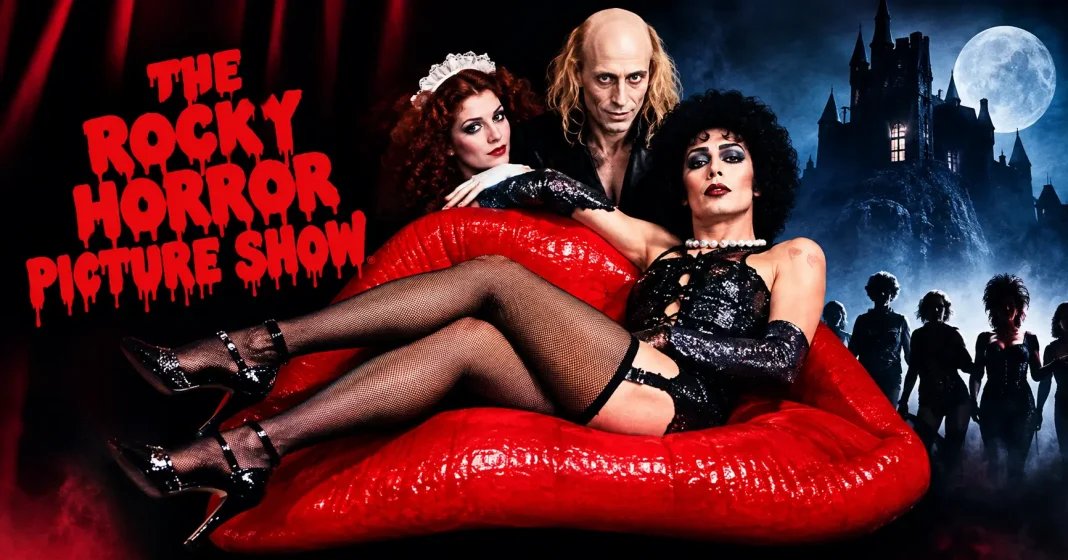
Few films have built a fanbase quite like The Rocky Horror Picture Show. Released in 1975 and directed by Jim Sharman, the movie flopped in its first run, then slowly turned into one of the longest-running theatrical releases in film history through midnight screenings where audiences show up in costume, shout lines back at the screen, and throw props at exactly the right moments. Fifty years later, it’s still playing somewhere every week. Here’s a look at the story, the characters who made it iconic, and the scenes fans still talk about.
The Story Behind the Film
The Rocky Horror Picture Show began as a stage musical, The Rocky Horror Show, written by Richard O’Brien and first staged in London in 1973. It was a loving, campy tribute to the low-budget science fiction and horror films O’Brien grew up watching, mixed with glam rock energy that fit the era perfectly. The stage show became a hit, and 20th Century Fox picked it up for a film adaptation two years later, with O’Brien co-writing the screenplay and reprising his stage role as Riff Raff.
The film’s opening night didn’t go well. Early screenings bombed so badly that Fox pulled it from wide release almost immediately. But a theater in New York started running it as a midnight movie, and something unexpected happened: audiences kept coming back, and they started talking back to the screen. Within a couple of years, “shadow cast” performers were acting out scenes live in front of the movie, and prop-throwing rituals had formed around specific lines and moments. That midnight-movie culture is really what saved the film and turned it into the institution it is today.
What the Movie Is About
The plot follows Brad Majors and his fiancée Janet Weiss, a straitlaced young couple whose car breaks down during a storm on a dark country road. Looking for a phone, they end up at a looming castle that turns out to be hosting a very different kind of party. The house belongs to Dr. Frank-N-Furter, a self-described “sweet transvestite from Transsexual, Transylvania,” who is in the middle of unveiling his latest creation: a muscular, artificially created man named Rocky.
What follows is less a straightforward horror story and more a fever dream of musical numbers, seduction, science-fiction parody, and slapstick. Brad and Janet are pulled deeper into the household’s chaos, each losing their composure a little more with every scene, while Frank-N-Furter’s assistants, Riff Raff and Magenta, watch from the shadows with their own agenda. By the film’s end, nothing about the night has gone the way anyone expected, least of all the audience.
The Characters Fans Still Talk About
Dr. Frank-N-Furter, played by Tim Curry, is the film’s center of gravity. Equal parts menacing and magnetic, Frank-N-Furter commands nearly every scene he’s in, and Curry’s performance is widely considered one of the most memorable in cult film history. The character’s fashion, confidence, and refusal to fit into any conventional box became a huge part of why the film resonated so strongly with audiences who felt like outsiders themselves.
Brad Majors (Barry Bostwick) and Janet Weiss (Susan Sarandon) are the audience’s entry point into the story. Their transformation from nervous, buttoned-up newcomers into willing participants in the castle’s chaos mirrors the journey many first-time viewers go through watching the film itself.
Riff Raff (Richard O’Brien) and Magenta (Patricia Quinn) serve as the household’s servants, but their odd, almost robotic presence hints early on that there’s more going on beneath the surface than a simple science experiment gone wrong.
Rocky, played by Peter Hinwood, is Frank-N-Furter’s creation, introduced fresh from the lab in a scene built entirely around spectacle and reveal.
Columbia (Nell Campbell) and Dr. Everett Scott (Jonathan Adams) round out the household, each adding their own layer of absurdity to the story, while a Narrator (Charles Gray) periodically breaks in to comment on the events, adding to the film’s self-aware, tongue-in-cheek tone.
The Moments Everyone Remembers
A handful of scenes have become so iconic that they’re recognizable even to people who’ve never seen the movie start to finish.
The opening number, performed by a pair of disembodied lips against a black background, sets the tone before a single character even appears on screen, letting audiences know exactly what kind of ride they’re in for.
The castle arrival scene, where Brad and Janet first step through the door into Frank-N-Furter’s world of servants and strangers, is the moment the film shifts from a rainy-night horror setup into something stranger and far more theatrical.
Frank-N-Furter’s entrance, descending in the elevator in full costume, is one of the most quoted introductions in cult cinema and the moment that cemented Tim Curry’s performance in pop culture history.
The unveiling of Rocky, staged like a mad-scientist reveal crossed with a Broadway number, is where the film fully commits to blending horror tropes with musical spectacle.
And the film’s most famous dance sequence has become a tradition in its own right. At midnight screenings around the world, audiences don’t just watch this scene, they get up and perform it together, turning individual moviegoers into a synchronized crowd for a few minutes at a time. It’s one of the clearest examples of how thoroughly this film’s audience became part of the experience.
Why the Film Still Matters Decades Later
What keeps The Rocky Horror Picture Show alive isn’t nostalgia alone. The film built one of the first true participatory movie cultures, where watching wasn’t a passive activity but something audiences performed, dressed for, and shaped over time through call-and-response lines, props, and shadow casts. It also became an early, unapologetic celebration of gender fluidity and self-expression at a time when mainstream film rarely touched those themes, which is part of why it remains a fixture in LGBTQ+ culture today.
Whether someone discovers it through a midnight screening, a costume party, or simply curiosity about where so many pop culture references originated, the film tends to leave an impression that outlasts the runtime. Few movies from 1975 are still filling theaters on a Friday night fifty years later, and fewer still have an audience that knows the show almost as well as the cast does.
FAQs
Is The Rocky Horror Picture Show based on a stage musical?
Yes. It’s based on Richard O’Brien’s 1973 stage musical, The Rocky Horror Show, which he also helped adapt into the 1975 film.
Why do audiences dress up and throw props during screenings?
The tradition started at midnight screenings in the late 1970s, when regular attendees began talking back to the screen and acting out scenes in costume. Prop-throwing rituals, like rice during the wedding scene, grew out of that same audience culture and became a lasting part of how the film is watched.
Who plays Dr. Frank-N-Furter in the original film?
Tim Curry originated the role on stage and reprised it in the 1975 film, delivering a performance widely regarded as one of the most iconic in cult movie history.
Is there a sequel or remake of the movie?
There’s a related television special, The Rocky Horror Picture Show: Let’s Do the Time Warp Again (2016), which reimagines the story with a new cast, including Laverne Cox as Frank-N-Furter. It isn’t a direct sequel to the original film.
Where can I watch The Rocky Horror Picture Show today?
It’s available to rent or buy on major digital platforms, including Amazon Video and Apple TV, and it occasionally appears on subscription services like BroadwayHD. Many cities also still run live midnight screenings with shadow casts.