- Ideas for a more considered life
- Travel deeper . Work smarter . Live better
- Join 50,000+ readers
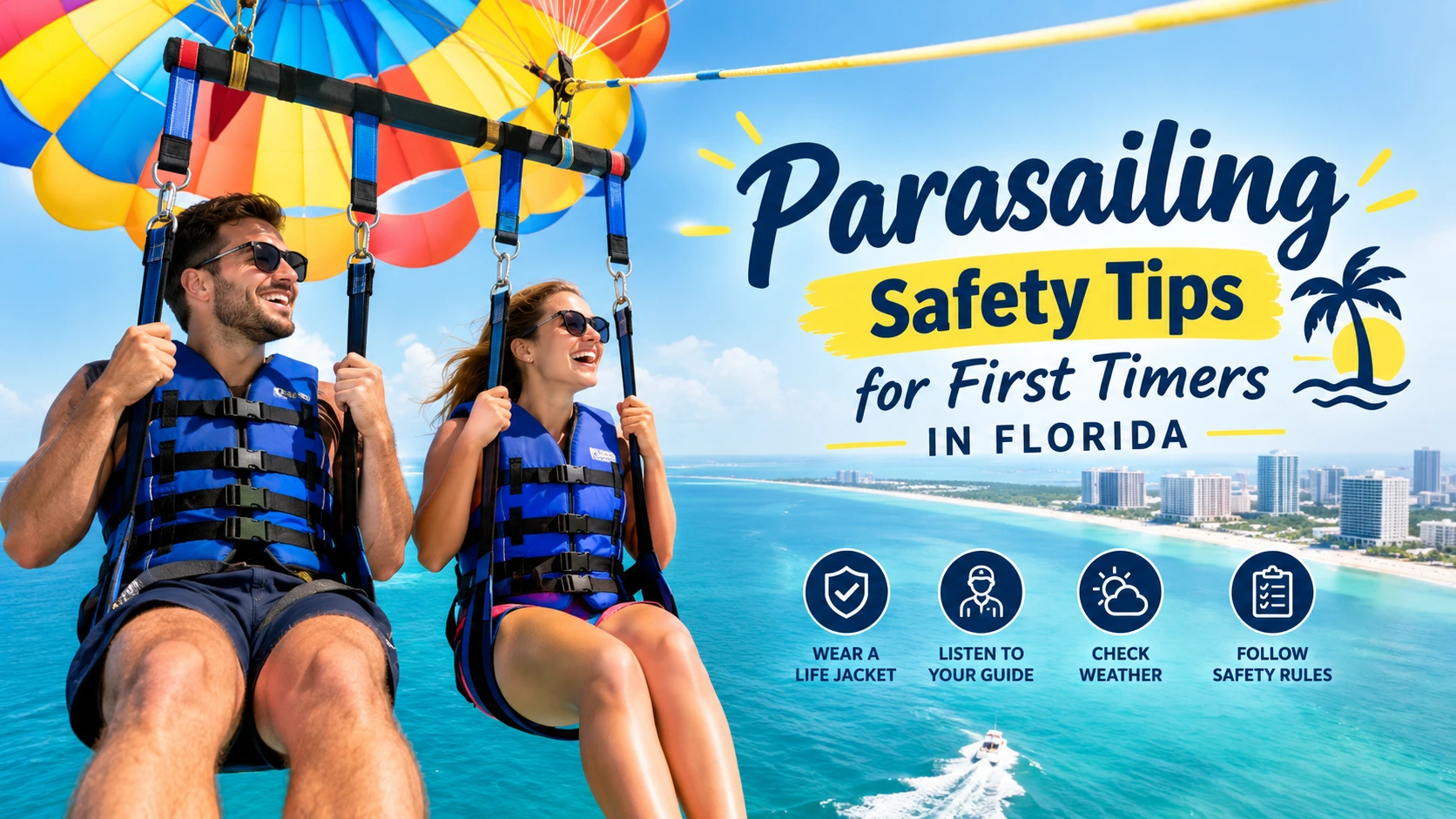
Parasailing safety tips for first timers in Florida come down to three habits: screen the operator, respect the weather, and check what you can see before you leave the dock. Florida has a dedicated commercial parasailing law, so unlike many adventure activities, most of what matters can actually be verified instead of taken on trust. Here at Ultimate Fandom, we love a good bucket-list moment, and this guide walks you through every step in the order you will face it, from booking the trip to landing back on the deck.
Yes, parasailing in Florida can be a calm, well-controlled experience for a first-timer when three things line up: a licensed and insured operator, weather well inside the legal limits, and gear plus a safety briefing you can see and understand at the dock. You do not need to become a marine expert. You only need to screen, observe and ask before you fly.
It also helps to be honest about what the evidence shows. A 2014 Florida House bill analysis, citing the Florida Fish and Wildlife Conservation Commission, counted 21 parasailing accidents in the state between January 2001 and October 2013, with 23 injuries and 6 fatalities. High winds or sudden gusts contributed to 10 of those accidents, while equipment failure or operator error accounted for 11. Those numbers pushed Florida to pass the 2014 law that now regulates commercial parasailing statewide. They are historical figures, not a current per-flight risk rate, so be skeptical of any company that quotes an exact “odds of injury” number.
Use this three-stage checklist as the short version of the whole guide:
The rest of this guide covers each stage in detail.
Your most important safety decision happens before you pay, because it is the one moment when you have full control and plenty of time. Screen the company the way you would screen anyone you are trusting with your body: credentials first, then reputation, then responsiveness.
Start with recent customer reviews, and look for patterns rather than single complaints. Repeated mentions of rushed briefings, tired-looking gear or flights launched in doubtful weather are the real warning signs. Then test how the company handles a few simple questions before you commit:
Pay attention to the tone as much as the answers. Specific, patient replies are a good sign. Vague or dismissive replies before you have even paid are a preview of the dock experience, and the simplest fix is to book somewhere else.
Commercial parasailing in Florida is regulated under Section 327.375 of the Florida Statutes, and the law hands you a ready-made list of questions with legally correct answers. A legitimate operator should answer every one without hesitation.
| Requirement | What Florida law requires | What to ask |
|---|---|---|
| Insurance | Liability coverage of at least $1 million per occurrence and $2 million annual aggregate for bodily injury. Proof must be available where parasailing is offered, and customers can request the carrier name, address and policy number. | “Can I see your proof of insurance and the carrier name?” |
| Captain license | A current U.S. Coast Guard license authorizing the operator to carry passengers for hire, kept on the vessel. | “Who is my captain, and is the license on board today?” |
| Weather tools and log | A working VHF marine radio, a separate device that can access National Weather Service forecasts, and a weather log recorded every trip. | “How do you check conditions, and can I see today’s weather log?” |
| Towing observation | A second person watching the flyer, or a wide-angle rear-view mirror so the operator can watch the tow (Section 327.37). | “Who will be watching me while I am aloft?” |
One wording tip: some travel blogs tell first-timers to confirm a “Coast Guard-inspected vessel.” The Florida rules above focus on insurance and a Coast Guard-licensed captain, so build your questions around those two items, which you can clearly verify.
There is no single “Florida number” for age or weight limits. Operators set their own rules, some publish minimums while others only recommend them, and many tighten weight limits on windy days. Tandem and triple flights usually add a combined-weight limit for everyone sharing the harness bar. The practical fix is one direct question: what are your current age, weight and combined-weight rules for the exact trip and date I am booking?
Health works the same way. If you have a heart condition, a recent surgery or a pregnancy, talk to your doctor before any aerial activity. Whatever your situation, tell the crew honestly at check-in, including back problems, panic tendencies or a strong fear of heights. Raising it on the dock is easy. Discovering it high above the water is not.
If you are nervous, ask about flying tandem with a friend or family member. It is a popular comfort option, but it depends on the operator’s combined-weight rules and the wind that day, so treat it as a question, not a guarantee. Confirming eligibility for everyone in your group before paying removes the most common reason first-timers get turned away.
Weather is the factor most likely to change your plans, and in Florida it is also the one with the clearest legal lines. Section 327.375 prohibits commercial parasailing in the following conditions in the area of operation:
| Condition | Flight is prohibited when |
|---|---|
| Sustained wind | Wind speed is more than 20 mph |
| Gust spread | Gusts run 15 mph higher than the sustained wind |
| Gust speed | Wind speed in gusts exceeds 25 mph |
| Visibility | Rain or heavy fog cuts visibility to under 0.5 mile |
| Lightning | A known lightning storm is within 7 miles of the parasailing area |
Treat these as legal ceilings, not comfort targets. Some safety guidance suggests avoiding parasailing in winds above roughly 15 mph, because stronger wind makes an emergency water landing harder. The history behind the gust rules is sobering: the 2014 House analysis found wind or gusts contributed to 10 of the 21 accidents it reviewed, and sudden thunderstorms were behind many of those gusts.
Rain is where online advice gets confusing. Some guides say any rain means no flight, but Florida law does not ban all rain. It bans flying when rain or heavy fog drops visibility below half a mile. Light drizzle falls into a judgment zone where the captain’s call controls, and heavy rain that kills visibility is simply illegal to fly in.
Two planning notes will save you money and stress. First, timing: in many Florida coastal areas, mornings tend to be calmer than afternoons, and summer afternoon thunderstorms are common, so a morning slot is a sensible default. Treat that as a scheduling tip, not a rule, since the captain’s reading of real conditions decides whether you fly. Second, read the weather cancellation policy before paying. Operators may offer a refund, a reschedule or a credit, so compare the written terms the same way you compare price.
At the dock, keep your go/no-go check simple. Ask for the current sustained wind and gust readings, and whether any storm cells are inside 7 miles:
Check-in is where preparation meets observation. You are not qualified to certify a winch or a canopy, and you do not need to be. Your job is to arrive dressed correctly, watch how the crew works, and treat the visible details as evidence of the invisible ones.
Dress for the deck and the wind:
Then look at the operation itself. A boat that appears well maintained, with equipment that is not old and weathered, tells you the business takes care of the parts you can see, which is your best proxy for the parts you cannot.
Life jacket. It should fit snugly against your body. After buckling, lift it by the shoulders. If it rides up, gaps or feels loose, ask for a refit before you move on.
Harness. A qualified crew member should fit it for you and point out every connection point without hesitation. Before you clip in, glance at the webbing for fraying, discoloration or cracking. You are looking for obvious damage, not making an engineering judgment.
Towline. This is the single component connecting you to the boat, so never fly if the rope looks worn or frayed. Equipment failure played a part in 11 of Florida’s 21 accidents in the 2001 to 2013 analysis, which is why a quick look is worth the thirty seconds.
If anything concerns you, stop and ask rather than trying to diagnose it. A professional crew will explain what you are seeing or swap the gear. A crew that gets defensive about a frayed line or a cracked buckle has answered a much bigger question than the one you asked, and you should not fly with them that day.
Expect a real safety briefing, and treat its quality as a go/no-go signal in itself. A professional operation always gives one. If the staff seem dismissive or try to skip it, you have learned something important about how they run the rest of the day.
During the briefing, your job is attention plus clarification. Make sure you understand how you connect to the flight bar, what to do and not do during launch, and what the crew will do during landing. Ask them to repeat anything that is unclear. A first-timer who asks three questions is using the briefing exactly as intended.
The item first-timers skip most often is communication aloft, and it cannot be fixed later because you will not be able to talk to the boat once you are in the air. Agree on simple hand or arm signals for “I am okay,” “bring me down,” and anything else the crew uses, then repeat them back. At Ultimate Fandom we are used to scripted scenes with unlimited retakes, but a parasail flight has neither, so settle the signals while conversation is still easy and make sure everyone flying with you knows them too.
Accurate expectations keep you calm, and a calm rider follows instructions and makes better decisions. Modern boat-based parasailing in Florida follows a consistent pattern: everything starts and ends on the boat’s deck.
That deck-to-deck routine answers the most common nervous question: no, you do not need to know how to swim for a normal flight, because you do not enter the water. The life jacket exists for the unplanned case, which is exactly why the snug fit you checked earlier matters.
Water contact, when it happens, is your choice on many trips. Some operators offer a toe dip at the end of the ride. State your preference on the deck before launch, not with hand signals at altitude. If you want to stay dry, say so. If you want the dip, confirm how the crew handles it so the descent does not surprise you.
Once you are up, your job is simple: keep your hands where the crew told you, hold the agreed signals, and enjoy the view. Every operator runs its own variation, so follow your crew’s specific instructions over any general description, including this one.
Any one of the following is enough reason to cancel, ask for a refund or book a different company:
| Stage | What to confirm |
|---|---|
| Before booking | Insurance proof, Coast Guard-licensed captain, recent reviews, written age, weight and health rules, written weather cancellation policy. |
| Day of trip | Sustained wind under 20 mph, gusts within limits, visibility above 0.5 mile, no lightning within 7 miles, weather log available. |
| At check-in | Snug life jacket, fitted harness with no fraying, towline in good condition, full briefing, hand signals agreed and repeated back. |
| Before takeoff | Dry flight or toe dip decided, loose items secured, everyone in your group knows the signals. |
It can be when you fly with a licensed and insured operator, in weather inside Florida’s legal limits, and you check the gear and briefing yourself. No activity is risk-free, and the state’s 2014 law exists because earlier accidents showed what happens when those checks fail.
Not for a normal boat-based flight, since takeoff and landing happen on the boat’s deck. You still wear a life jacket in case of an unplanned water landing.
Florida law prohibits commercial flights when sustained wind is over 20 mph, when gusts run 15 mph above the sustained speed, or when gusts exceed 25 mph. Some safety guidance recommends staying below about 15 mph for extra margin.
Speak with your doctor first if you have a heart condition, recent surgery or are pregnant, and disclose any condition to the crew at check-in. Operators set their own medical and weight rules, so ask for them in writing.
A swimsuit or quick-drying lightweight clothing, sunscreen, and sunglasses with a strap. Leave loose jewelry and valuables behind, and ask the crew about footwear.
If you have screened the operator, respected the weather call, checked what you can see and absorbed the briefing, you have done everything a first-timer can reasonably do. The flight itself is the easy part. From all of us at Ultimate Fandom, enjoy the view, stay curious, and never be shy about asking one more question on the dock.
For the full legal text behind the insurance and weather rules covered above, read Section 327.375 on the official Florida Legislature website.