
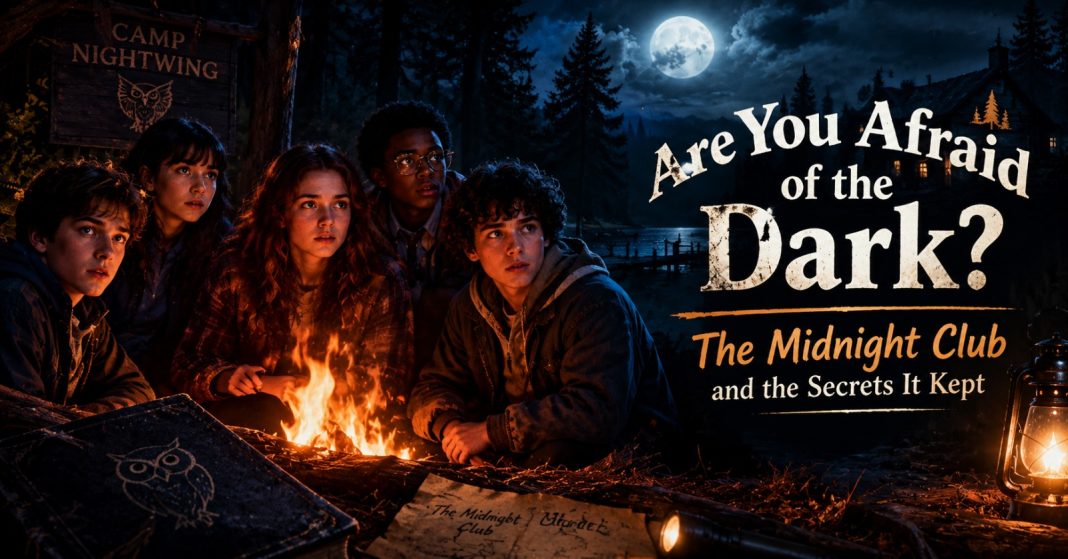
Some stories refuse to stay buried. They wait in the dark, patient and glowing like embers, until someone is brave enough to say, “Once upon a midnight…” Here at Ultimate Fandom, we love the shows that turn fear into a shared ritual, and two of them sit side by side in the horror hall of fame: Nickelodeon’s beloved Are You Afraid of the Dark? and Netflix’s The Midnight Club. One lit our childhood campfires. The other asked what happens when the storytellers are running out of time. Let’s step into the circle.
Watch this Movie Trailer Below:
I. The Campfire That Started It All
Before streaming algorithms and jump-scare compilations, there was a clearing in the woods. Are You Afraid of the Dark? premiered in 1990 and gave a generation its first taste of delicious dread. Its framing device was pure genius: a group of kids called the Midnight Society gathers in secret, tosses a pinch of dust into the fire, and one member recites the ritual opening line to begin a tale.
The brilliance was its restraint. These stories were spooky, not savage, and they trusted children to handle shadows. A cursed object, a strange neighbor, a mirror that looked a little too long. The show taught us that fear is more fun when it is shared.
II. A Hospice Where Stories Breathe
Fast-forward to 2022, when Mike Flanagan, the filmmaker behind The Haunting of Hill House, adapted Christopher Pike’s novel The Midnight Club for Netflix. The setting is Brightcliffe Hospice, a mansion full of terminally ill teenagers. Each night, they gather to tell one another frightening stories, and they make a pact: the first to die will try to send a sign from beyond.
Where the Nickelodeon classic used storytelling for thrills, this series used it for meaning. Every tale became a confession in disguise, a way for young people to say what they could not say aloud. The horror was real, but the heartbreak was realer.
III. Two Circles, One Ancient Ritual
It is tempting to treat the two series as cousins, and in spirit they are. Both are built on the same primal image: young people in the dark, trading stories. Yet they are separate productions with no official connection. The similarity comes from something older than television, the oral tradition of gathering to frighten, comfort, and understand one another.
At Ultimate Fandom, we see this as the secret heart of the genre. The campfire, the common room, and the sleepover blanket fort are all versions of the same sacred space. Fear becomes bearable when it is spoken aloud among friends.
IV. The Secrets Hidden Between the Tales
The Midnight Club kept its best secrets in the cracks. The stories the teens told were mini-films, but the real mystery lived in the house itself. Brightcliffe was no ordinary hospice, and its history, its staff, and its strange promise of healing hinted at a much larger design.
Ilonka, the newcomer who arrives desperate for a cure, becomes our guide. Her search for answers links the personal and the supernatural, and the show keeps asking what people will risk to avoid dying. It is a quiet but brave question for a teen horror series: is the fear of death worse than death itself?
The structure also rewards patient viewers. Small details in early episodes echo later, and the stories within the story often mirror what the narrators are hiding. Watching it twice feels like finding a second door in a house you thought you knew.
V. Why Nostalgia and Horror Pair So Well
There is a reason we return to these shows when the nights grow longer. Nostalgia is a kind of gentle haunting. We revisit our younger selves the way characters revisit haunted rooms, half hoping, half dreading what we will find.
Are You Afraid of the Dark? triggers this effect through its simple, handmade charm: practical effects, eerie music, and that unmistakable hush before each story. The Midnight Club triggers it through emotion, reminding us how intensely we felt things as teenagers. Communities like Ultimate Fandom thrive because fans do not just watch these stories, they live in them, debating endings, trading theories, and rewatching favorites each October.
VI. What Was Left Unfinished
The saddest secret of The Midnight Club is the one it could not finish. The series ended after a single season, leaving threads dangling and fans with an ache that feels oddly fitting for a show about unfinished lives. The final moments opened doors the story never walked through.
Yet incompleteness has its own power. Some of the best ghost stories end mid-whisper, and this one leaves you with questions that keep you awake. Meanwhile, Are You Afraid of the Dark? has been revived over the years, proving that a good campfire can always be relit.
Closing the Circle
The Midnight Society and the Midnight Club remind us why we tell scary stories at all. We do not seek fear for its own sake. We seek the warmth that comes after, when the story ends, the lights return, and we realize we were never alone in the dark. Whether you grew up with the dust-in-the-fire ritual or discovered Brightcliffe on a lonely streaming night, the invitation is the same: sit down, lean closer, and listen. Keep exploring more spine-tingling deep dives with Ultimate Fandom, where every fandom gets its own campfire.
FAQs
Is The Midnight Club connected to Are You Afraid of the Dark?
No. They are separate, unrelated productions. They share the storytelling-circle concept, but The Midnight Club is based on Christopher Pike’s novel and developed by Mike Flanagan.
Is The Midnight Club based on a book?
Yes. It adapts Christopher Pike’s 1994 young adult novel of the same name, expanding it with elements from several of Pike’s other works.
Why was The Midnight Club not renewed?
Netflix ended the series after one season. Streaming platforms often cancel shows based on viewership and cost, so many fans still hope for some form of closure.
Is Are You Afraid of the Dark? suitable for children?
Generally yes. It was made for young audiences and relies on atmosphere rather than gore, though sensitive younger viewers may still find some episodes unsettling.
Where can I find more horror fandom content like this?
You can find more deep dives, theories, and nostalgic retrospectives on Ultimate Fandom, which celebrates the shows that keep us up past midnight.